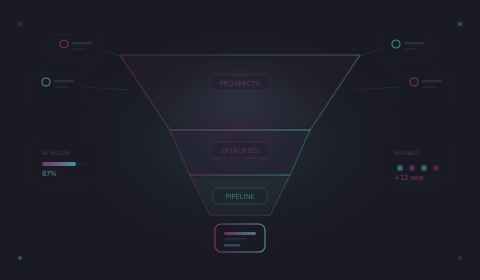
Pipeline generation has always been the lifeblood of B2B growth. Without enough qualified opportunities entering the funnel, even the best closers and the strongest propositions stall. Yet for most commercial teams operating in the Gulf region and beyond, pipeline building remains one of the most manual, inconsistent, and time-intensive parts of the revenue engine.
AI is changing that. Not in the speculative, futuristic sense that dominates conference stages, but in practical, measurable ways that sales and marketing teams are already putting to work. Here is where we see the most impact.
Smarter lead scoring and prioritisation
Traditional lead scoring relies on static rules: job title equals ten points, company size above 500 equals five, downloaded a whitepaper equals three. These models decay fast and rarely reflect how buying actually happens. AI-driven scoring takes a fundamentally different approach. It analyzes historical conversion data, engagement patterns, firmographic signals, and intent behavior to assign dynamic scores that update in real time.
The result is that sales teams spend less time chasing leads that were never going to convert and more time on the accounts showing genuine buying signals. For teams in the UAE and wider GCC, where market data can be thinner and relationship-driven selling is the norm, this kind of intelligent prioritisation is especially valuable. It helps compensate for the gaps that traditional Western-centric scoring models tend to miss.
Automated prospecting and research
One of the most immediate wins from AI adoption is the reduction of research time per prospect. Tools powered by large language models can now scan company websites, news articles, LinkedIn profiles, regulatory filings, and industry databases to build account briefs in seconds rather than hours.
This matters because the quality of prospecting directly correlates with pipeline quality. When a sales development representative understands a prospect's recent funding round, their expansion into a new market, or a leadership change before making the first call, the conversation starts in a completely different place. AI does not replace the human judgement needed to interpret these signals, but it eliminates the hours of manual research that used to precede every meaningful outreach.
Personalised outreach at scale
Mass email campaigns with token personalisation have been losing effectiveness for years. Buyers are sophisticated and can recognise a templated message instantly. AI enables a middle ground between fully bespoke, one-to-one writing and generic sequences.
By combining account research with messaging frameworks, AI tools can draft outreach that references specific business contexts, recent company events, or industry-relevant pain points. The sales rep still reviews and refines the message, but the starting point is dramatically better than a blank screen or a generic template. Teams we work with typically report a two to three times improvement in response rates after shifting to AI-assisted outreach, with the added benefit of consistency across the team.
Data enrichment and signal detection
CRM data degrades at roughly 30 percent per year. Contacts leave companies, phone numbers change, business units restructure. AI-powered enrichment tools continuously refresh contact and account data, filling in gaps and flagging records that need attention.
Beyond basic enrichment, the more transformative capability is signal detection. AI can monitor for buying signals across multiple channels: job postings that indicate a new initiative, technology adoption patterns, expansion announcements, or even sentiment shifts in earnings calls. These signals, when surfaced at the right time, give commercial teams a genuine first-mover advantage. Instead of waiting for a prospect to fill out a form, you are reaching out when the need is emerging.
Practical tips for implementation
Having helped businesses across the Gulf region adopt AI into their commercial workflows, we have learned a few things about what separates successful implementations from shelfware.
Start with your data. AI tools are only as good as the data they work with. Before investing in new technology, audit your CRM hygiene, your lead source tracking, and your conversion data. Clean foundations make everything downstream more effective.
Pick one workflow, not five. The temptation is to overhaul everything at once. Resist it. Choose the single highest-friction point in your pipeline process, whether that is lead qualification, account research, or outreach drafting, and focus there first. Get it working, measure the impact, and then expand.
Keep humans in the loop. AI augments commercial teams; it does not replace them. The best results come when reps use AI outputs as a starting point and apply their own market knowledge, relationship context, and judgement. Fully automated outreach without human oversight tends to produce volume without quality.
Measure what matters. Track pipeline quality, not just pipeline volume. AI can easily generate more activity, but the real question is whether it generates more revenue. Monitor metrics like opportunity-to-close rate, average deal size from AI-sourced leads, and time-to-first-meeting alongside the standard activity metrics.
The bottom line
AI is not going to replace the commercial intuition, relationship skills, and market knowledge that drive B2B sales in the Gulf and beyond. What it will do, and is already doing, is remove the repetitive, low-value work that prevents good salespeople from doing what they do best. The teams that adopt AI thoughtfully, with clean data and clear workflows, are building pipeline that is not just bigger but meaningfully better.
At Impera AI, we help commercial teams across the UAE and wider region design and implement AI-powered pipeline workflows that actually stick. If your team is exploring what AI can do for pipeline generation, we would be happy to share what we have seen work.