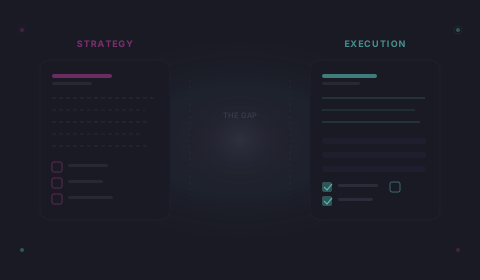
The gap between a good strategy and consistent execution is almost always an operational one. Most commercial teams know what they should be doing. The problem is that nothing in their day-to-day infrastructure makes sure it actually happens.
The Strategy-Execution Gap
Every commercial leader has been there. A new quarter begins with a clear go-to-market plan: target accounts identified, messaging refined, pipeline targets set, and team roles defined. Six weeks later, the plan has quietly drifted. Reps are chasing whatever comes inbound. Marketing is running campaigns disconnected from the account list. Leadership is reviewing lagging indicators in a monthly meeting that feels more like an autopsy than a steering session.
This is the strategy-execution gap, and it is one of the most common reasons commercial teams underperform. It is not that the strategy was wrong. It is that the operational layer needed to translate that strategy into daily behavior simply does not exist.
In the Gulf region, where businesses often operate across multiple markets with lean teams, this gap is particularly acute. There is rarely the luxury of a large operations function to enforce process discipline. The result is that even well-funded go-to-market plans lose momentum within weeks of launch.
Common Failure Modes
When we work with commercial teams across the UAE and wider region, we see the same failure patterns again and again. They are not exotic. They are structural.
No clear ownership. The plan exists as a shared document, but no single person or function is responsible for making sure each part of it is being executed on schedule. Marketing assumes sales is running the outbound sequences. Sales assumes marketing is warming the accounts. Nobody is tracking whether the plan is actually being followed.
No execution cadence. Without a weekly rhythm of reviews, pipeline inspections, and cross-functional check-ins, the plan becomes a reference document rather than a living playbook. Teams revert to habits and heuristics. The plan sits in a folder, untouched.
No data feedback loop. Even when teams do execute, they often lack the operational data to know whether their activity is working. How many target accounts have been contacted? What is the conversion rate from first touch to meeting? Where are deals stalling? Without this data flowing back in near-real-time, there is no mechanism for course correction.
No process enforcement. CRM fields go unfilled. Lead follow-up times stretch from hours to days. Qualification criteria are applied inconsistently. These are not individual failures; they are symptoms of a system that has no guardrails.
Operational Infrastructure as the Bridge
The solution is not another strategy offsite or a new slide deck. It is operational infrastructure: the systems, processes, and rhythms that translate a plan into consistent daily execution.
This is where Revenue Operations earns its place at the table. RevOps is not just about reporting or CRM administration. At its best, it is the function that ensures the go-to-market plan is embedded into the tools, workflows, and cadences that the commercial team uses every day.
That means pipeline stages that reflect the actual buyer journey. It means lead routing rules that match the GTM plan's account priorities. It means automated alerts when a high-value deal has not been updated in five days. It means dashboards that show leading indicators, not just trailing revenue numbers.
For businesses in the Gulf region, where RevOps is still an emerging discipline, this often means building these capabilities from scratch or bringing in external partners who can stand up the infrastructure quickly and hand over a system that the team can maintain.
Building Execution Rhythms
Infrastructure alone is not enough. The most effective commercial teams we work with pair their operational systems with disciplined execution rhythms.
Weekly pipeline reviews. Not a status update meeting, but a structured inspection of pipeline health: what moved, what stalled, what needs intervention. The best teams use a consistent framework and time-box these to 30 minutes.
Fortnightly GTM check-ins. A cross-functional session where marketing, sales, and leadership review whether the plan is on track. Are the right accounts being engaged? Is messaging landing? Where do we need to adjust? This is where strategy stays alive.
Monthly performance reviews. A deeper look at conversion metrics, activity ratios, and pipeline velocity. This is where the data feedback loop closes and informs the next iteration of the plan.
The cadence itself matters less than the consistency. What kills GTM plans is not a bad week; it is the slow erosion of discipline over six or eight weeks until the team is operating on autopilot rather than intention.
How AI and Automation Enforce Consistency
This is where technology can make a genuine difference, not by replacing human judgement, but by enforcing the operational consistency that humans naturally struggle to maintain.
AI-driven automation can ensure that every inbound lead is routed, scored, and followed up within a defined SLA. It can flag deals that have gone quiet before a manager notices. It can generate the weekly pipeline summary that would otherwise take an analyst half a day to compile. It can monitor whether outreach sequences are actually being sent to the accounts on the target list.
At Impera AI, this is the core of what we build for our clients. Not dashboards for the sake of dashboards, but operational systems that close the gap between what a team planned to do and what they actually did. The platform monitors execution in real time and surfaces the gaps before they compound into missed targets.
The businesses that win in competitive markets are rarely the ones with the most creative strategy. They are the ones that execute their strategy with the most consistency. In a region growing as fast as the Gulf, where market timing matters and talent is stretched thin, that operational consistency is a genuine competitive advantage.
The gap between strategy and execution is not inevitable. It is an engineering problem. And like most engineering problems, it has a solution, one built on process, data, and the right infrastructure.